
Why your Environment Dictates your Focus (and How to Exploit it)
The 3 step system to force deep work in an optimized workspace

I wasted two hours staring at a whiteboard. It wasn’t a lack of discipline, it was because my desk was a disaster.
An important post was due tomorrow, bringing that familiar knot of anxiety. But I stood at my whiteboard, optimizing a workflow with four different markers, instead of typing a single word.
For two hours, I felt incredibly productive. I finished the new system, I looked at the clock and reality hit me:
Under the illusion of work, I had produced absolutely nothing.
We are told to push through distraction.
That is a broken strategy. You don’t magically become focused. Focus is a biological reaction to the environment around you.
Working at my cluttered desk felt extremely annoying; I wasn’t able to focus. So my brain felt the need to flee from a toxic environment and it chose the easier option. It optimized a system that already worked well thinking it was being productive.
Stop relying on willpower. Start tricking your biology. And it starts with your workspace.
Phase 1: The Sensory Blackout
Shrink Your Visual Field
Your brain is made to scan the room for movement. Working in a bright open room seemed enjoyable and efficient. Until I realized my eyes were catching every single distraction.
Here is the invisible trap: You have to make a micro-decision not to pick up your phone or your mail every time your eyes notice them.
You are actively draining your focus and energy just by sitting next to your mess.
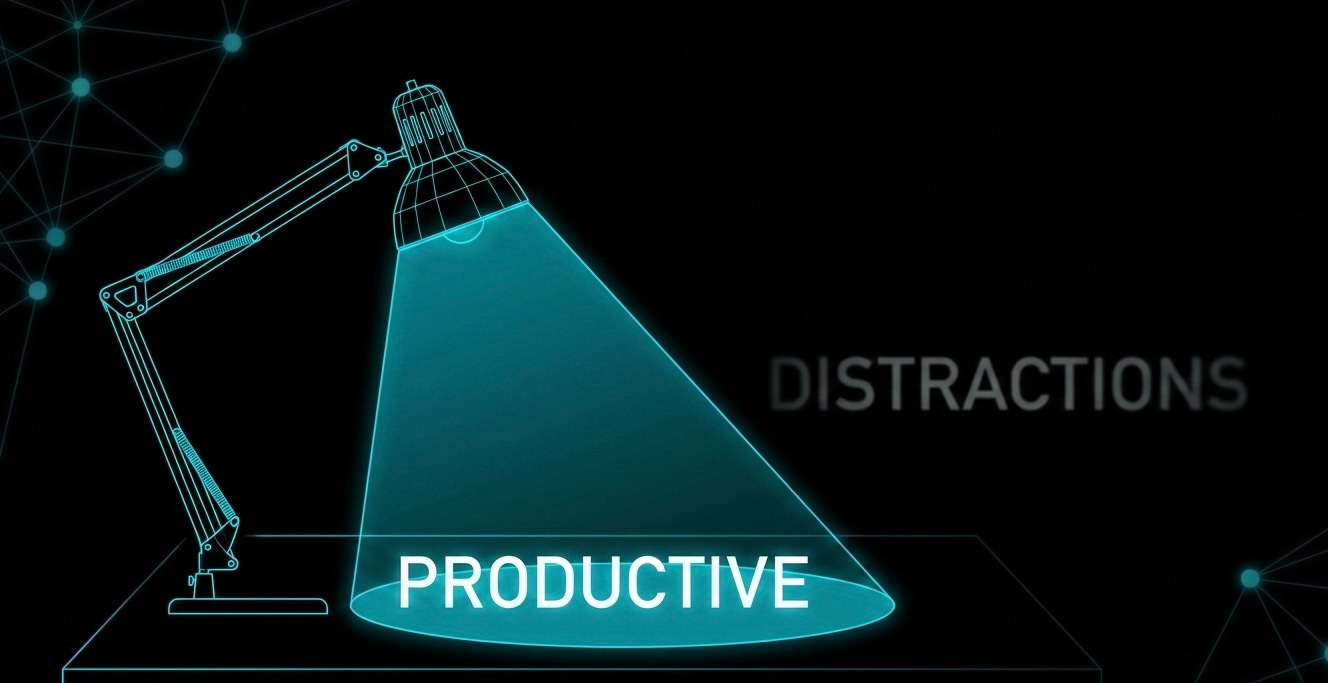
The Fix: Turn off the lights. A single, harsh desk lamp should be aimed at your keyboard.
The Science: Your nervous system increases your alertness when your visual field is narrow. Removing the sight of the clutter allows you to focus exclusively on what is in front of you.
Lock Down Your Ears Next.
People put pop music into their headphones to block out the room, but this is a flawed strategy.
I used to blast my favorite playlist thinking it helped me work. Instead, I focused on the lyrics, following the music more than anything else. I almost completely ignored the blank page in front of me.
The Fix: Play white noise, binaural beats, or a steady, lyric-free song.
The Science: The steady sound hitting your ears acts as a wall. It silences the noise of your house (or office) and stops your brain from wasting energy trying to decipher background conversations or catchy melodies.
Once your eyes and ears are protected from distractions, you have to teach your brain how to start up deep work.
Phase 2: The Brain Conditioning
Define The Chair (And The Soundtrack)
Your brain is a conditioning machine. It runs on the exact same biology as Pavlov’s dog. He rang a bell and the dog salivated; looking for food (because was conditioned to know that the bell always came along with a snack).
The same principle applies to you. If you sit in a specific chair and hear a specific hum, your brain starts preparing for output, because it knows it’s time to work.
But an issue arises when the signals are mixed.
I used to eat lunch, watch YouTube and try to write all at this exact same desk.
My brain was completely lost. It had no idea what to do every time I sat down. So, it defaulted to the easiest option. I ended up staring at my phone.
The Fix: Pick one physical spot for high-output work, and pair it with your preferred background noise from Phase 1.
The Science: If you sit down at that desk, you type. That is the only rule. When you combine the location with the exact same audio every single time, you build an automatic and easy trigger for deep work. The environment starts dictating the behavior.
But even the perfect room cannot completely stop the feeling of procrastination. For that, you need dedicated systems.
Phase 3: The Failsafes
System 1: The Friction Tax
Your brain is fundamentally lazy. It wants the easiest path. So, make the bad habit very annoying to start.
My hand literally tried reaching for my phone when I put it in another room. It was embarrassing, but it proved how automatic the reflex is. Don’t just put your phone face-down on the desk. That is too easy to grab.
Put it inside a zipped backpack, inside a closet, in the next room.
If you want to check your messages, you have to walk twenty steps and undo three zippers.
When you make the procrastination harder to access than the actual work, your brain will choose the work just to save energy.
System 2: The Ejection Seat
You are allowed to quit. But you cannot do it in the workspace.
The exact moment you feel the urge to watch a YouTube video or draw useless flowcharts, you must stand up. Walk to the kitchen and waste your time somewhere else.
Your desk must remain a “sacred space” for output. Remove the distraction from the work zone entirely. If you don’t, you will destroy your automatic trigger for deep work.
The Reality Check
Maybe you don’t use a whiteboard to hide from your work.
Maybe your version of this is reorganizing your Notion workspace for an hour. Maybe it’s suddenly deciding to deeply clean your kitchen, or spending 45 minutes looking for the perfect focus playlist on Spotify.
It is all the exact same trap. It is your brain looking for an escape because your environment is too hard to focus in.
You cannot out-work a toxic physical setup. Your workspace dictates your output more than people think.
You have to stop crossing your fingers and hoping you will suddenly find the focus you need. Build the systems. Close the lights. Fix the room.
Read every word and I am also happy with how you explained how the brain some times trick us in doing the job that requires less effort and I also liked how to provided a solution to the usual things that always distract us
Really resonated with this. I like how you frame focus as a biological response to environment rather than pure willpower. The idea of conditioning your brain through space and sound is powerful, especially the reminder that clutter quietly drains energy through constant micro-decisions. What was the single change that had the biggest impact on your ability to sit down and actually start?
I’ve subscribed and would be happy to support each other.
Jorrit